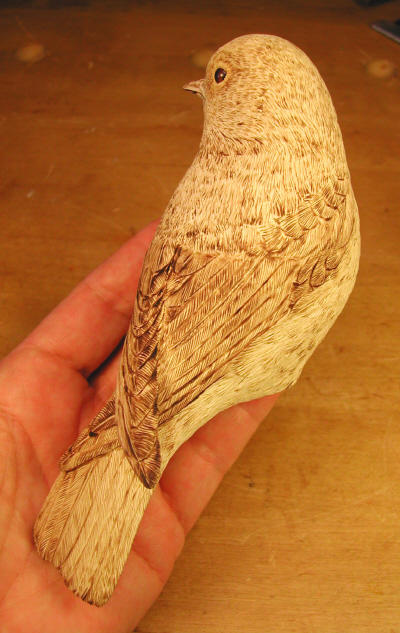
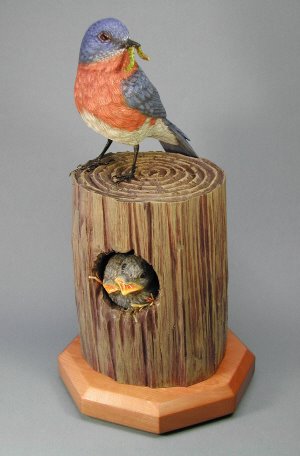
Bluebird Carving by 'woodworks-by-donna'

With this blog I'll be keeping a diary, with photos, showing the development of a commissioned carving from conception to completion. It will take the month of October, since it is due at the beginning of November. I expect that documenting the process will help to keep me on track. Here is my website to see more of my carvings: www.woodworks-by-donna.com

Wednesday, November 09, 2005

Final Installment


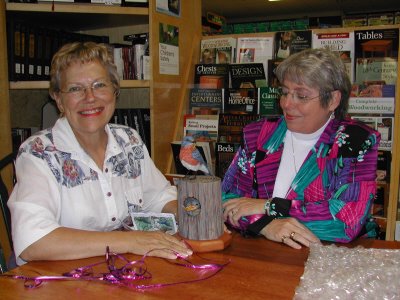
Here it is, the final entry for this blog. Last night I met with the women involved and delivered the sculpture into their hands. I think they liked it- they seemed really excited about it
We met at the Austin, Texas Woodcraft store where I used to work.

Coincidentally, the Central Texas Woodcarvers' Association was meeting there at the same time. Really. . . I didn't plan it that way, but it was great to be able to 'show and tell' my latest work with lots of carving buddies.
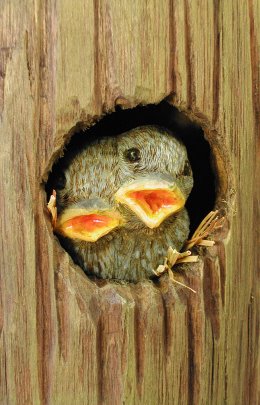
Its funny how just a little bit of hay seems to finish off this piece. Until the hay was attached there was 'something missing'- something that was just not quite right. Voila! A couple of pieces of hay and all is well.


Thanks to everyone for their interest in my project. Here is a link to my web site where you can see many more carvings and other woodworking projects:
http://www.geocities.com/donpbk/woodworks-by-donna.html
See you there!

Saturday, November 05, 2005

It is all over but the shouting


Haven't posted for a while because I couldn't get here with Internet Explorer- although I had done so many times before. So I just switched to Firefox and I'm back in business.
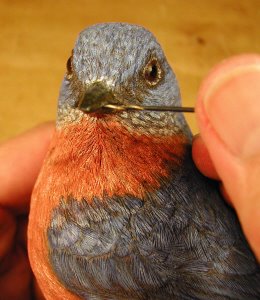
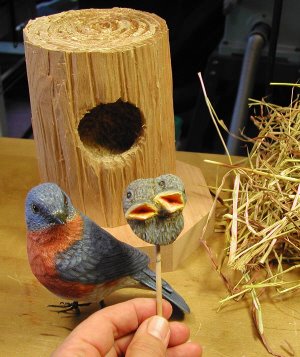
No, I'm not fossing the bluebird's teeth- lol! Actually I'm hand drilling a tiny hole through the bird's beak. Through this hole I'll thread a fine brass wire and then attach the ends of the wire to the two ends of the worm I've carved and painted.
Talk about fussy work- try carving a worm 1" long and 1/8" in diameter, out of figured maple wood. Then I cut it in half, drilled a couple more holes with the #55 drill, painted it kind of a camouflage green/brown, and then attached it to the ends of the wire coming out of the beak. Looks good.


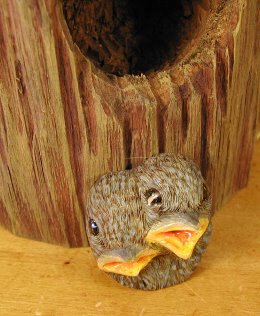
The babies are done now, with shiny, hungry mouths and eyes. The post has been antiqued with muted shades of violet and yellow. Since they are complementary colors they cancel each other out (in our eyes/brains) and the result is a gray looking old post. To keep the birdies in place inside I used two supporting rods attached to the birds and the inside of the post hole. One goes from the back of the birds to the back of the cavity, and the other goes from the bottom of the birds into the bottom of the hole. They are attached with epoxy now and should be quite secure.


Here is the top of the base. Notice how oiling brings out the depth in the wood. This is a very special piece of mesquite wood that a friend gave to me years ago. I wanted a refined look to the base to work as a contrast to the rough-looking post.
I won't be showing a photo of the completed project until Wednesday, the 9th, after I deliver it on the 8th. I figure the purchaser and the new owner ought to be the first to see it. I will post photos then, as well as their reaction to getting the piece. I'm sooooo excited! Hope they like it.

Monday, October 31, 2005

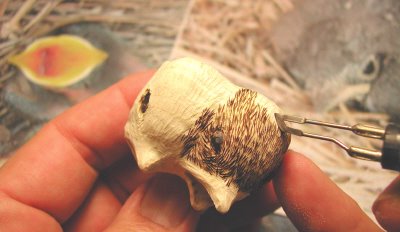
Burn, babies, burn

So now it is time to burn these little guys and give them some detail. In the background you can see some of the reference photos I found on the internet. Someone had taken almost day-by-day photos of nestlings in a bird house. It was great to have actual photos for reference. Never use someone else's art work for reference. They may have it wrong.


These three guys are finished, but there is a problem. I'd planned for the third birdie to be sleeping in, so I kept his eyes and mouth shut. Unfortunately this made him look like a dead birdie- not good for the composition. So I ruthlessly carved him away and made his head into the shoulder of the other bird. It was a hard decision to make, but seemed necessary.
Now, I like it better.
You must keep flexible on a project like this and keep open to new ideas.


Here it is all ready for assembly. I've nuked some hay so it won't have any bugs in it. Their nest seem to be mostly composed of dried grasses.
The babies are on a stick, ready to be inserted into the hole in the post hole. They will be secured with epoxy and the nest built around them.
Mr Bluebird looks a little disconcerted by their presents, but he will get used to them after a while.
Oops- he needs to have something in his beak to feed the hungry mouths. Hmm- one green worm coming up.

Friday, October 28, 2005

I'm counting on you all

Site Meter
You will notice a new addition to this page- a site visit counter. This is a simple one that just counts hits- no other data on the viewers. I have been curious how many people are following my progress- and I don't get many comments- so this will be one way to find out. It will only measure this page, but I assume that anyone interested will want to view all the pages.

Now, onto new developments. the baby
birdies have been quite a challenge for
me. I have the book on carving
songbirds by Ernie Muhlmatt and he
carves lots of baby birds, but none of
them are set up in a hole like these are.
So I'm kinda playing it by ear. First I
rough carved them to shape using some
very aggressive, though small, tools.

Some progress has been made here in
refining the shape of the birdie beaks
and setting them apart from one another.
They look strange in the post hole right
now, but with some nesting material
added to the mix I think it will look
just great. These babies will have to
be finished just like the daddy bird,
but not in such great detail, so it
will not take so long. I am crowding
the time limit though, and I still
have to construct a nice base. I'm
planning to make it octagonal, but I
need to check my supplies to see what
beautiful wood I have in stock that
will complement the composition.

Wednesday, October 26, 2005

Fence post posting


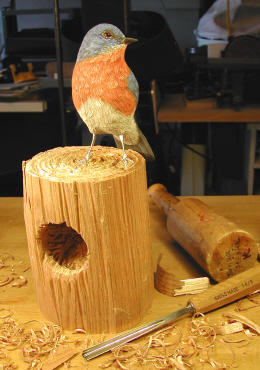
Allrighty- the fence post was done in 3.5 hours! Amazing, I had figured it would take a few days. After feeding the cows and moving a few bales of hay from the back of the barn; feeding the chickens and giving them fresh, clean water; and emptying and refilling the ducks water pool I still managed to find some energy for carving. Sometimes you get into the carving 'zone' when time stands still and everything goes right. That was this afternoon.
Of course, I drew blood 3 times- minor- and developed a few blisters on my fingers- and hurt all over, maybe coming down with something- but it was worth it. Mr Bluebird thinks it needs some work before he will move in.


Why, you may ask, don't I just use a nice, old fencepost with a hole already in it? Three reasons: first, if I want to enter the piece in a show, I need to make all but the feet and eyes from wood- not found wood; second, that old fence post may have an infestation of bugs or rot that the customer may not want in her house; third, just to prove that I can.
Except for cutting the block to size and drilling the hole, the entire post was carved with hand tools- no power. The butternut split off large hunks beautifully using the large carving chisel and a mallet.


Now the post has some character- old and beat up. I have an unfair advantage over other artists when it comes to rendering old fence posts. With fifty acres of Texas ranch, fenced with some 75 year old posts, I have seen and worked with many posts that looked just like this. The weather eats away the top surface, which I emulated by carving concentric grooves with this round-ended V-gouge. Then I opened out the grooves until there was just a pointed ridge on the top of each area, and then broke up some of those ridges. All that, and the grooves around the circumference of the post, were made by just that one tool.


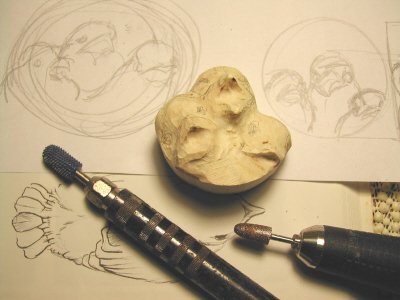
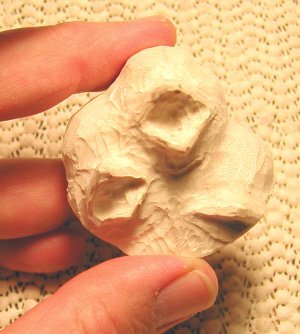
Then it was time to fit the blank for the babies
into the hole. It looks a little like an egg at this point. Hmmmmm


The babies are just a gleam in Mr Bluebird's eye at this point, but soon they will come to life. They are essentially a relief carving and I'm not sure how to handle it, but the post came out OK- so not to worry. I'll just take away whatever doesn't look like a baby bird and whatever is left will be the birdies.

Monday, October 24, 2005

Finished bluebird, but not finished composition


Here the orange is getting a lighter coat. Next
the white is lightened and a few details are added
Finally some touches of iridescent paint to bring
the feathers to life.

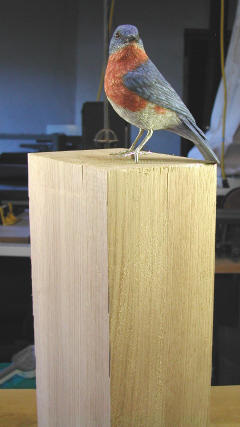
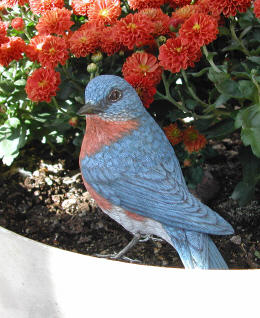
This is a comparison of the finished bird with the reference that both the customer and I thought was the best photo we could find. I used many other references, but this was the main one.

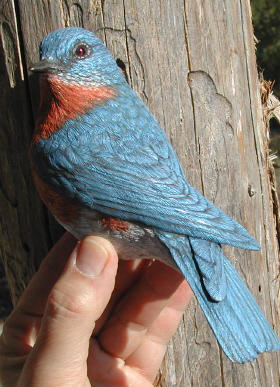
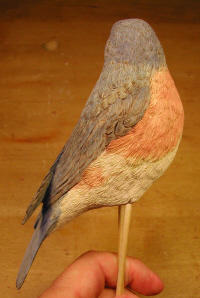
This back biew of the bird still looks dark, but the light is deceiving. Once he got into the sunlight his feathers really shined.


He thinks he looks mighty handsome- he is even thinking about finding a mate- if only he can get out of the studio. . .
So I took him out for a little sunshine and before I knew what was happening he flew right out of my hand and started to explore the back yard.
This grasshopper thought the bluebird was interesting- but then the bluebird got hungry-
lunchtime!


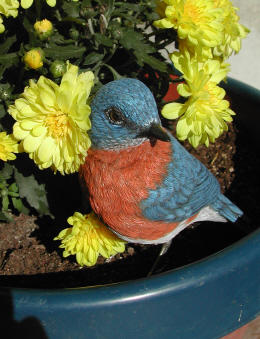
He checked out the yellow flowers. . .


. . . and then the orange blooms caught his eye. He likes the way they match his breast.


Oh oh- he has spotted a likely cedar fencepost that he thinks will make a great place to raise a family. It has a hole in it that was made
by a woodpecker. Now to find
a bride who will lay some eggs
in the hole- then we will
have babies to feed.
Hmmm- lets see, bugs, insects,
worms, larvae, and catepillars
will have to be brought to the
baby birds. That will be a tough
job, but he is up for it.

Friday, October 21, 2005

Lighten up!

So now the
paint
thickens,
and the
lighter
colors are
applied. It may seem drastic, but this is just the first of the lighter coats.
After the tiny strokes of lighter blue are applied there is a pleasant intermingling of the different shades of blue to create a shimmering effect.


OK- so I just put this one in because it is so cute. The blue is all but complete, but the russet and white areas need lots of lightening.
Going over and over each feather is getting old- so I'd better finish up soon. Tomorrow should be the last day- final lightening and iridescence- then start on the post and babies.

The blue bluebird

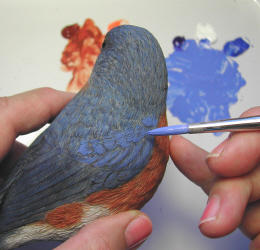
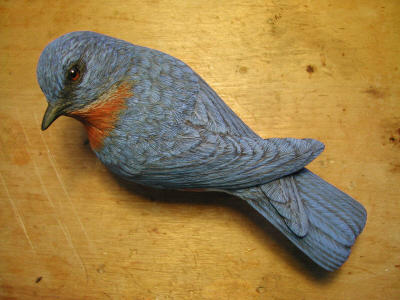
Here is a detail of the shoulder after the second coat. I wanted to show how thin the coats are- and that you can see the details of the burned feathers. Also note the blending of the colors to make smooth transition from breast to neck to wing and back areas.
Working this thinly allows me to fool around with colors and placement for quite a while. If I don't like the result I just paint over the previous layer. Eventually, the top coats will carry the day.


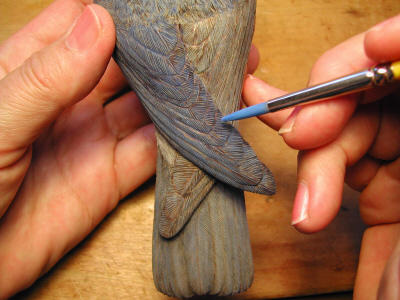
The next photo shows me painting one of the third coats on the wing. Actually, I painted pure cobalt first- but that wasn't the right color. So then I mixed cobalt with ultramarine to get the right color. It is real dark now, but I needed that to get sufficient darkness into the details and shadowed areas.

Wednesday, October 19, 2005

Second Coat

Here is a look at my painting work station. It is at my hand-carving bench in the studio, on the second floor of my home. I have lots of brushes for when I teach people how to make the butterflies, hummingbirds, and dragonflies. We use good brushes because you cannot do a good job with bad brushes. If a brush does not cost over $3 it is not good enough. Sorry, but that is just the way it works. You see my duckie helper here- I don't even try to do good art work without his help. Some of my paint tubes are more than 10 years old and the paint is going bad. It will be fun to buy some new tubes soon.
The first coat of paint, the undercoat, was used primarily to define the color areas.
The second coat of paint is not much thicker than the first coat. It is a little darker than the first coat and will make the shadowed areas.
I'm really just staining the wood and not applying paint at this point. I'm a wussy painter- not very bold, but I like the effect that ultimately results from many thin coats.

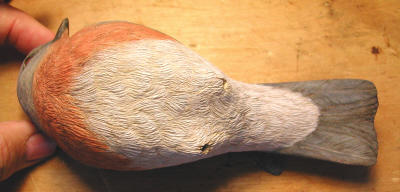
The color is not very intense,but it is starting to build up. On the belly you can see some discrete greyish lines to indicate shadowed areas.
Now the color will start to be more intense and the fun begins.

Tuesday, October 18, 2005

Underpainting


The first coat of paint is called the undercoat. It is usually done very thinly and with muted colors. You know if the paint has been thinned enough if you can paint on a piece of printing and can easily read through the paint. That is very thin, but we don't want to obliterate all the fine burned details, now do we. I am following my own painting scheme here, but refering to the color mixture and details in the book. I was missing about half of the recommended
colors, so I had to improvise. The blue is ultramarine, cobalt, white, raw umber, and a little violet. The russet is burnt siena with a little white and black. The white is white with some of the russet mixed in to warm it up. The black is ultramarine and raw umber. It isn't very pretty now, but succeeding coats of paint will make great improvements. You'll see.

Bluebird, bluebird, burning bright. . .


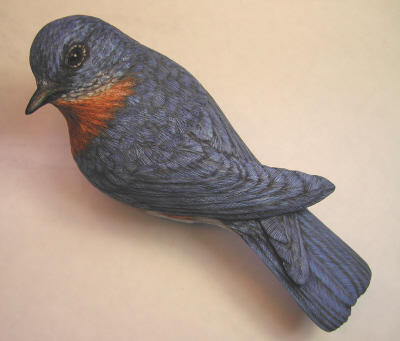
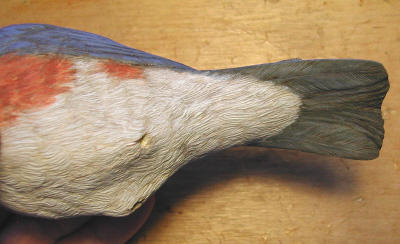
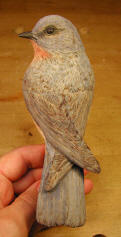
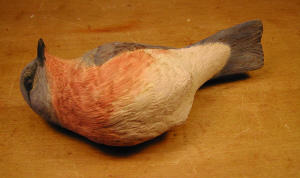
This is the flank of the bluebird after woodburning and before painting. Each of the the feather groups is different and required different techniques in carving, stoning, and burning.
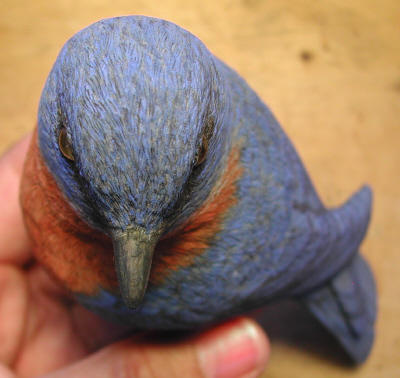
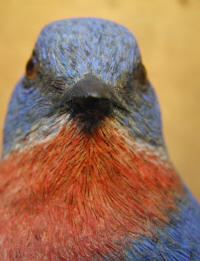
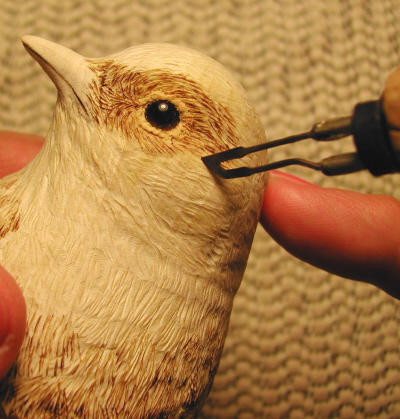
Working on the face area requires a delicate touch and a good woodburner. The hummingbirds I've done were a lot smaller than the bluebird and took a lot less time to burn. This guy took 3 days of 1 hour sessions- probably 5-6 hours all together. I used a fan to pull the smoke away from me, but my eyes still tire after a short while.
This is the finished, burned bird, front view. Some of you have asked for the name of the book I mainly used for this carving. It is:
Carving Award Winning Songbirds, by Lori Corbett. The book is very well done, her directions are easy to follow and she gives lots of information on how to make your own variation on her bluebird. It is a great reference book on carving and finishing birds as well as giving specific plans and instructions for the Cedar Waxwing, Red-Breasted Nuthatch, and Mountain Bluebird.


Here is the back view of the finished burn. Someone asked me how tedious this was and I said that it was like threading a needle- except- try to thread 120 needles in an hour.
Lori Corbett has a neat forum where people talk about her book, and she has a website where you can order the book directly from her. http://www.whisperingeagle.com.
Check it out!
Meanwhile, back at the ranch, I'm going to be painting today. Yippee! Painting is fun and easy.

Friday, October 14, 2005

Half-way Point

Looks good for finishing by the end of the month. Some more woodburning and the big bird will be ready for paint. I have a lot of experience with painting carvings, so it should not take more than a couple of days.
Since the last update the legs were trial fit into drilled holes, as were the eyes.

Here I'm using a power carving attachment called a stone. I have modified it to make groves within the feather clusters.
The eyes have been set into their sockets with an epoxy putty. The eyelids are missing and will be added later.
Some of the wing feathers hve been emphisized with the woodburning skew tool. The beak has been thinned more, and I think it is just about right.
The head has been refined a lot. Lots of wood has been removed, and it looks more and more like a bluebird.
You can see the tool in use adding barbs to the wing feathers. I feel at home using the burner- I've burned a lot of carved birds.

Here the left wing is almost done with burning. This is an intense job that is very eye straining, so I limit myself to an hour at a time. If you want a challenge to patience and eye-hand coordination just try to make bird eyelids out of epoxy putty. They are finished here. Doesn't he look intelligent now?
On the left the carving's
wings are nearly done.
I thought you woould like to have a look at the workbench where I'm making the bird.
Reference materials on the left, bird under the light, dust collector in the background, micro-carver next, then the wood burner. Hanging are the powerful Foredom and a lesser Dremel flex shafts. I shudda cleaned up before taking the photo. What a messy workspace!

Monday, October 10, 2005

Progress after a hurdle

For some reason that I don't understand, sometimes the photos just refuse to load. That is why it has been so long between postings. I managed to get this far before it froze up- so I'll add more photos later.
Had a problem with the tail. I'd left it too fat and the ends of the feathers looked very strange. Ruminated on the problem for a couple of days. Looked through all my reference books on technique and figured out how to fix the problem. First, needed to straighten out the tail. Used a compass to orient the tail in the correct direction, then fixed it.


Then I needed to thin the tail a bunch-
loosing all the previous hard work in
the tail area- top and bottom.
But at least I had a good clean slate
and a good idea of how to proceed.
It is a good feeling to feel that I've finally gotten it right.


I used my usual feather definition technique- using a wood burner instead of a power tool. It felt much safer to me. Here the tail feathers have been layered, with the proper overlap and continuity from the top to the bottom sides.


Whew! Glad to have that out of the way- meanwhile, three days had gone by. Time to get serious.


Here some of the 'lumps and bumps' have been carved into the wood. One of the ways to get a lifelike animal is to break up surfaces with various textures. First some major muscle groups were defined, and now the feather groups. the holes have been drilled- a very anxious time- and the legs temporarily fitted to the bird.

Tuesday, October 04, 2005

Now THAT'S a Bluebird

Today the bird became a bluebird. You can tell it is not a wren, not an eagle, nor a hummingbird. So far, so good.
Reduced abdomen, moved legs waaaay back, rounded the head fore and aft, separated the wing tips, refined the wings to make them straighter, and sweated bullets over 'getting it right'. Talk about separation anxiety. Separating those thin tail feathers about gave me an ulcer. Have to admit I chickened out and did a lot of the final finishing with hand sanding. I wasn't about to take a chance of nicking a finished area. The tips of the tails are cross-grain and very delicate, so they will have to be handled very carefully. I support the delicate parts with my fingers while working on them.

End of day #3

Spent most of the time yesterday in refining the shape to make it less blocky. Birds are streamlined. Then again, bluebirds are kinda rounded looking. While walking to the mailbox I observed 4 bluebirds on the telephone wire. They had very short tails. So I thought that maybe I should make mine even shorter. then I realized that these were probably adolescent birds and I'm carving a daddy bird. I think the tail is just about right, but there seems to be too much abdomen. It surely would have been easier if I'd just copied the bird in the book, but then it would not have been 'my' bird.
I also worked a lot on the wings. It is important to make the wings look like they are overlapping. It ain't easy. Musta worked 2 hours just on the wings today. Still a lot left to do. Notice the reference material photos behind the bird. Sure would help if I had a pet bluebird to look at- or a frozen specimen. You would not believe the road-kill stored in my freezer!

Sunday, October 02, 2005

Starting to look like a bird- any bird


Got to spend about 3 hours today on the bird. Working the power carvers like crazy. A couple hours of that and you can no longer see straight, your fingers tingle, and you get a craving for fresh air. On the left I'm refining the underside of the tail area after thinning and shortening it a whole bunch. On the right I'm working on the top side of the tail. Using a coarse cloth-backed paper in the 'tootsie-roll' holder is more like carving than sanding. Lots of wood can be removed very quickly. Most of today's work was spent with the coarse carbide cutter followed with this 'sander'.


Since Mr. Bluebird is looking so much more like a bird I can hear the novices out there saying "heck, she must be nearly finished. I don't think so. The author of the book I'm using has 159 steps to carving and burning the details on the bird- I'm currently on #59. Only 100 left to go, and then there is the painting. Not to mention the cedar post and 3 babies- how I'm going to do that I have no idea.

I have projected 75 hours for this project, including an exotic wood turned base. So far I have about 15 hours into it- just 60 left to go.

Saturday, October 01, 2005

Day 1, Saturday, 10/01/05 Progress Apace

Today was a good day. It may not seem like that much progress was made, but I see 4 hours of blood, sweat, and tears. I've mentioned anxiety before and I'll bet you are wondering what could be producing anxiety on a simple woodcarving. Below, you will see what looks like the murder of my poor bird, but in fact I was just reducing the area under the chin so I could refine the beak. I'm using a particularly viscious tool called a tungsten carbide bit, in a Foredom power carving tool.

Guess what would happen if I hiccuped, or sneezed, or burped. . . yep, the beak would be mashed like a piece of hamburger. I don't like to have to glue pieces back onto my carvings, nor do I want to fill holes with wood putty. So I hold my breath and work very slowly and carefully.
Patience is the key.

So here is the result of today's effort compared to the original clay model. The wooden version is more refined and more accurate. So far I like the way the author is leading me through the steps to make the bird. I have some trouble translating from her bird's pose to mine, but I just vary a couple of steps and make it look like it should.

Getting Started on a Carving Commission

With this blog I'm planning to record my progress in making my latest carving commission. The client wants a bluebird carving and I don't anticipate too much trouble in making it. I've already put in quite a few hours in research, planning and preliminary development, but now that the deadline is drawing nearer I going to turn and burn and get it done by the end of this month. If I work a few hours each day I will make it.

First decision necessary was how to present the bird, since I won't make a 'bird on a stick' carving. I decided to place the male Eastern Bluebird on an old, weatherbeaten, cedar fencepost; and place a grasshopper in his beak. He will be looking over his shoulder to make sure there are no predators nearby, before he brings the food to his youngsters. On the side of the fencepost is a hole that was probably carved by a woodpecker looking for bugs. In the hole are three hungry, squawking baby bluebirds.

The next task was to research bluebirds and make a clay model. This is a rough clay sketch of the basic gesture of the bird. Then I used a plastic triangle to transfer the outline of the clay model to a piece of paper. It is important that there be enough wood on the blank to carve all the features of the bird, so he may look a little chubby.Now I can cut out the pattern, trace it onto a block of tupelo wood, and cut out the blank from which I'll carve the bird. Notice how strange the top view is because the head is turned and is subsumed by the outline of the body. I had tried to sketch this out without the clay model but found it impossible to visualize this relationship.

After bandsawing the block following the pattern lines I had a decidedly weird looking block of wood. It will take a lot of wood removal to make it look like a bird. The top three pieces show the original block and the waste cut from around the bird. Notice that although the sketch and clay model had the bird looking over his right shoulder, he is now looking to his left. Minor detail resulting from placing the pattern on the bottom of the block instead of the top of the block and failing to turn the pattern over. Not to worry, he will look just as good this way.

After a couple of hours of careful power carving the bird looks a lot more viable. I am trying a new carving technique espoused by the new book on which the bird is resting. The author starts from the beak, getting that oriented correctly and partly formed, and then takes all succeeding measurements from that point back. This is the 7th book I've bought on carving birds. You can never have too much reference material.